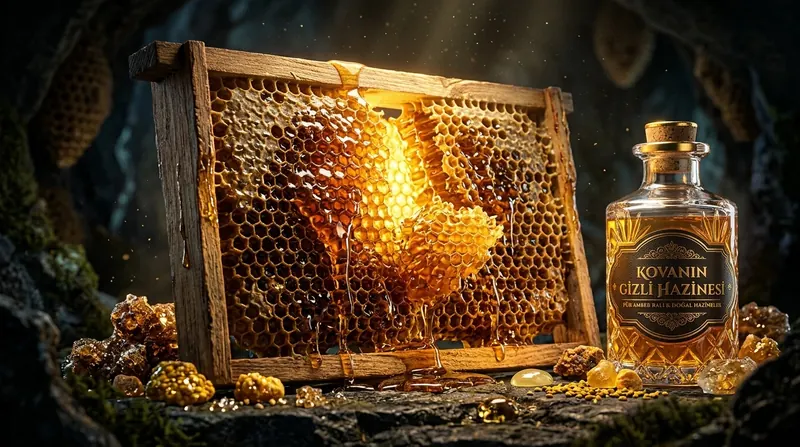
A honey bee hive contains one colony: a single egg-laying queen, thousands of female worker bees that do almost all the work, and, in the warm season, a few hundred to a few thousand male drones whose only job is mating. They live on wax combs made of hexagonal cells, with the brood (young bees) in the centre and honey and pollen stored around and above it. In summer a strong colony can reach tens of thousands of bees.
Let's open the lid and look at who is in there and how everything is arranged.
The three castes at a glance
| Queen (ana arı) | Worker (işçi arı) | Drone (erkek arı) | |
|---|---|---|---|
| Sex | Female | Female | Male |
| Number per colony | One | Thousands to tens of thousands | Hundreds to a few thousand, mainly spring and summer |
| Development, egg to adult | About 16 days | About 21 days | About 24 days |
| Typical lifespan | Usually a few years | About 5–6 weeks in summer, several months over winter | A few weeks to months; expelled in autumn |
| Sting | Yes, used against rival queens | Yes, barbed | No |
| Main role | Laying eggs | Everything else | Mating with queens from other colonies |
The queen: mother of the colony
The queen is the only fully developed female in the hive and the mother of nearly every bee in it. She is longer than the workers, with a slender abdomen that extends past her wings.
A few days after emerging, she flies out on mating flights and mates in the air with several drones from other colonies. She stores the sperm for the rest of her life and never mates again. Back in the hive, she lays eggs, and during the spring build-up a good queen can lay well over a thousand eggs a day.
She decides the sex of each egg: fertilised eggs become females (workers or queens), unfertilised eggs become drones.
How a worker larva becomes a queen
Queens and workers hatch from the same kind of egg. The difference is food. Larvae destined to be queens are raised in large, peanut-shaped cells and fed generously with royal jelly throughout development. Workers raise new queens when the old one is failing, lost, or when the colony prepares to swarm.
The queen also produces pheromones that hold the colony together. If she disappears, workers notice within hours.
Worker bees: a career in stages
Workers are smaller females that do not normally lay eggs. Their jobs change with age, roughly like this:
- Cleaning cells, in the first days after emerging.
- Nursing: feeding larvae with secretions from their head glands.
- Building comb with wax produced from glands on their abdomen.
- Processing nectar and storing pollen, and caring for the queen.
- Guarding the entrance.
- Foraging for nectar, pollen, water and plant resin, in the last part of life.
The order is flexible: if the colony suddenly lacks foragers, younger bees can switch roles earlier. In summer, intense foraging wears workers out within weeks. Bees born in autumn live much longer, clustering together through winter to keep the queen warm.
How workers turn nectar into honey is explained step by step in how bees make honey.
Drones: the males
Drones are stocky, with large eyes that meet at the top of the head, useful for spotting a queen in flight. They have no sting, do not collect food and are fed by workers.
Their purpose is to mate with young queens from other colonies at "drone congregation areas". A drone that mates dies in the process. When nectar runs short in autumn, the workers stop feeding the remaining drones and push them out of the hive, so a wintering colony usually has none.
How the comb is organised
Comb is built from beeswax in back-to-back layers of hexagonal cells. The hexagon uses wax efficiently and packs cells without gaps. Bees keep a precise gap, known as bee space, between combs so they can walk between them.
A typical brood comb looks like a set of rings:
- Centre: eggs, larvae and capped pupae (the brood nest).
- Around the brood: a band of stored pollen and bee bread, close to where nurse bees need it.
- Outer and upper parts: honey, often capped with fresh wax.
Drone cells are slightly larger than worker cells and are often found on the edges of combs.
The hive itself: modern box vs karakovan
Frame hives
Most beekeepers in Türkiye use wooden frame hives, the Langstroth type being the most common. The hive is a stack of boxes:
- a bottom board with the entrance,
- the brood box where the queen lays,
- optionally a queen excluder grid that workers can pass but the larger queen cannot,
- one or more supers where the bees store surplus honey,
- an inner cover and roof.
Inside hang removable wooden frames (çerçeve), usually fitted with a wax foundation sheet. Removable frames let the beekeeper inspect the colony and extract honey with a centrifuge, then return the empty comb.
Karakovan
The karakovan is the traditional Turkish hive: a hollow log, a wooden box or a basket without movable frames. Bees build their comb freely, attached to the walls. Honey from these hives is usually sold as comb honey and is especially associated with the Black Sea and north-eastern regions. Because the comb cannot be extracted and reused, yields are smaller. For eating tips, see honeycomb: how to eat and store it.
A year in the life of the colony
- Late winter: the queen restarts laying; the cluster slowly grows.
- Spring: rapid build-up, drones appear, colonies may swarm.
- Summer: peak population and main nectar flows; honey is stored.
- Autumn: drones expelled, brood reduced, long-lived winter bees raised.
- Winter: the colony clusters and lives on stored honey.
How this rhythm translates into harvest times across different Turkish regions is covered in our Turkish honey harvest calendar.
Which bees live in Turkish hives?
Türkiye sits where several honey bee subspecies meet, and it has some of the largest numbers of hives in the world. Well-known local bees include the Caucasian bee in the north-east, prized for its long tongue, and the Anatolian bee, adapted to the varied climate of the interior. The wide range of bees and flowers is one reason Turkish honeys are so diverse; read more in Anatolian flora and honey.
Conclusion
A hive is less a box of insects than a single, cooperative organism: one queen laying eggs, workers moving through a whole career of tasks, and drones waiting for a mating flight. Every jar of honey is the stored surplus of that system. If you would like to taste what Anatolian colonies produce, our raw blossom honey is available on the product page, and we are happy to answer questions on WhatsApp.
Frequently asked questions
How many bees live in one hive?
It changes through the year. A strong colony can have tens of thousands of bees in summer and far fewer in winter, but there is always just one laying queen.
Can a hive survive without a queen?
Not for long. Workers can raise a new queen from a young worker larva if one is available. If not, the colony gradually declines.
Why are drones thrown out of the hive?
Drones do not forage and must be fed. When nectar becomes scarce in autumn, workers stop feeding them and push them out to save winter stores.
What is a karakovan?
A karakovan is a traditional Turkish hive, such as a hollow log or box, without movable frames. Bees build natural comb inside, and the honey is usually sold as comb honey.
Do worker bees die after stinging?
Usually, when stinging mammals. The worker's sting is barbed and stays in the skin, tearing away from the bee. Queens have smooth stings and drones have none.