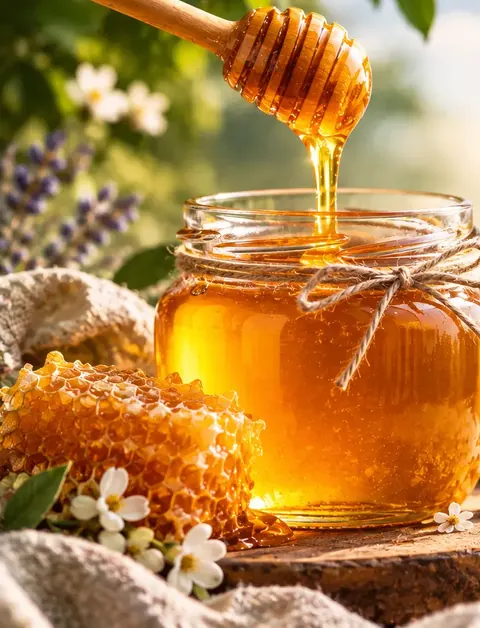
Honey that is properly sealed and stored stays safe to eat for a very long time, usually years beyond the date printed on the jar. It does not "expire" the way milk or meat does, because its high sugar content, low water content and natural acidity make it a very hostile place for microbes. Honey can, however, ferment if it takes on too much moisture, and its flavour and colour slowly change with age, so storage matters.
Below is a practical guide: why honey lasts, what the date on the label actually means, how to store it at home in Türkiye's varied climate, and the clear signs that a jar should go in the bin.
Why honey keeps so well
Several natural properties work together:
- Low water content. Ripe honey typically contains around 17–20% water. With so much sugar and so little free water, most bacteria and moulds cannot grow.
- High sugar concentration. Honey is mostly fructose and glucose. The sugar pulls water out of microbial cells, stopping them from multiplying.
- Acidity. Honey is naturally acidic, which further discourages microbes.
- Natural enzymes. Bees add an enzyme (glucose oxidase) that produces small amounts of hydrogen peroxide when honey is diluted, another hurdle for microbes.
Together these explain why sealed honey can stay edible for so long. But notice the first point: everything depends on the water content staying low.
What the date on the jar means
In Türkiye, as in most countries, honey jars carry a "best before" date (Tavsiye edilen tüketim tarihi, often abbreviated TETT) rather than a strict "use by" date (Son tüketim tarihi, STT). The difference matters:
| Label | Meaning | Applies to honey? |
|---|---|---|
| Best before (TETT) | Quality is guaranteed until this date; the food is usually fine after it | Yes, this is what honey uses |
| Use by (STT) | Safety date for perishable foods; do not eat after it | No |
Producers usually set a best-before period of a few years. After that date, a well-stored honey is normally still safe, but its quality may have shifted: it may be darker, its aroma weaker, and its HMF value (an indicator of age and heat exposure) higher. If you care about the honey's analysis values, fresher is better. If you simply want a sweetener for tea or cooking, an older jar in good condition is fine.
Crystallized is not spoiled
The most common reason people throw away good honey is crystallization. When honey turns cloudy, thick or grainy, that is a natural process in which glucose forms crystals. It happens faster in honeys rich in glucose and in cooler rooms.
Crystallized honey is perfectly edible. Many people prefer its spreadable texture. To make it liquid again, stand the jar in warm (not boiling) water and stir gently. Our article on why honey crystallizes explains the process in detail and why it is often a sign of natural, unprocessed honey.
When to throw honey out: signs of fermentation
Fermentation happens when honey absorbs extra moisture, usually from a wet spoon, a loose lid or humid air, and the natural yeasts in it become active. Check for these signs:
- Foam or bubbles on the surface or throughout the honey that were not there before.
- A sour, alcoholic or vinegary smell, like beer or wine, instead of a sweet floral one.
- A sharp, fizzy or tangy taste.
- A thin liquid layer on top of crystallized honey that smells sour. (A thin liquid layer alone can be harmless separation; the smell is the giveaway.)
- A bulging or hissing lid, caused by gas building up inside.
- Visible mould (rare in honey, but possible if water collected on the surface).
If you notice mould, a strong alcoholic smell or a bulging lid, discard the honey. Do not try to "rescue" it by heating. Mildly fermented honey is not usually dangerous, but it has lost its quality, and there is no reason to take chances.
Signs that are usually harmless
- White streaks or "frosting" along the inside of the glass (air bubbles and crystals).
- Darkening over time.
- A thicker, grainier texture.
- A few tiny wax particles or pollen grains in raw honey.
How to store honey at home
Good storage is simple, but it makes a real difference, especially in humid coastal cities like Antalya, Alanya or Trabzon.
Do
- Keep the lid tightly closed. Honey readily absorbs moisture and odours from the air.
- Store at room temperature, in a cupboard away from the stove, oven and direct sunlight.
- Use a clean, dry spoon every time. Even a drop of water, tea or butter adds moisture and microbes.
- Keep it in glass or food-safe containers. The original jar is usually best.
- Freeze large quantities if you buy a lot at once. Honey does not freeze solid at home freezer temperatures, and freezing slows crystallization and ageing.
Don't
- Don't keep it in the fridge unless you like it very firm. Cool temperatures speed up crystallization.
- Don't leave it in a hot car or on a sunny balcony. Heat speeds up darkening and HMF formation.
- Don't store it in unsealed metal containers for long periods.
- Don't mix old honey into a fresh jar. If one is starting to ferment, it can spoil the other.
How long will an open jar last?
A practical rule of thumb for a jar in daily use:
| Storage situation | Expected quality |
|---|---|
| Sealed, cool, dark cupboard | Excellent for years; best within the best-before period |
| Opened, lid closed tightly, dry spoon used | Excellent for many months to years |
| Opened, often left open or used with wet spoons | Risk of fermentation within weeks to months |
| Stored near the stove or in a hot place | Darkens and loses aroma faster |
A note on safety
Honey's long shelf life does not change two basic facts. First, honey is mostly sugar and should be eaten in moderation; if you have diabetes or another health condition, ask your doctor. Second, honey must never be given to babies under 12 months old, regardless of how fresh it is, because of the risk of infant botulism.
Conclusion
Honey does not expire in the usual sense. A sealed, well-stored jar stays good for years, crystallization is harmless, and only fermentation (foam, sour smell, bulging lid) or mould is a reason to throw it out. Keep it closed, dry and away from heat, and it will reward you for a long time.
If you would like a fresh jar, take a look at our raw flower honey. You can place your order online, by phone or on WhatsApp; we call you to confirm, you transfer the total to our IBAN with your order number in the description, and we ship once it arrives. Questions about storage? Call us any time before ordering.
Frequently asked questions
Can you eat honey after the expiry date?
Usually yes. Honey carries a best-before date, not a use-by date. If it has been sealed and stored away from heat and moisture and shows no signs of fermentation or mould, it is normally still fine to eat, although its flavour and colour may have changed.
How do I know if honey has gone bad?
Look for foam or bubbles, a sour or alcoholic smell, a fizzy taste, a bulging lid or visible mould. These indicate fermentation or spoilage. Crystallization and darkening alone are not signs that honey has gone bad.
Should honey be kept in the fridge?
It is not necessary. Room temperature in a closed cupboard is ideal. The fridge makes honey crystallize faster and become hard, though it does no harm.
Why does my honey smell like alcohol?
An alcoholic or sour smell means the honey has started to ferment, usually because it absorbed moisture from a wet spoon, a loose lid or humid air. It is best to discard it.